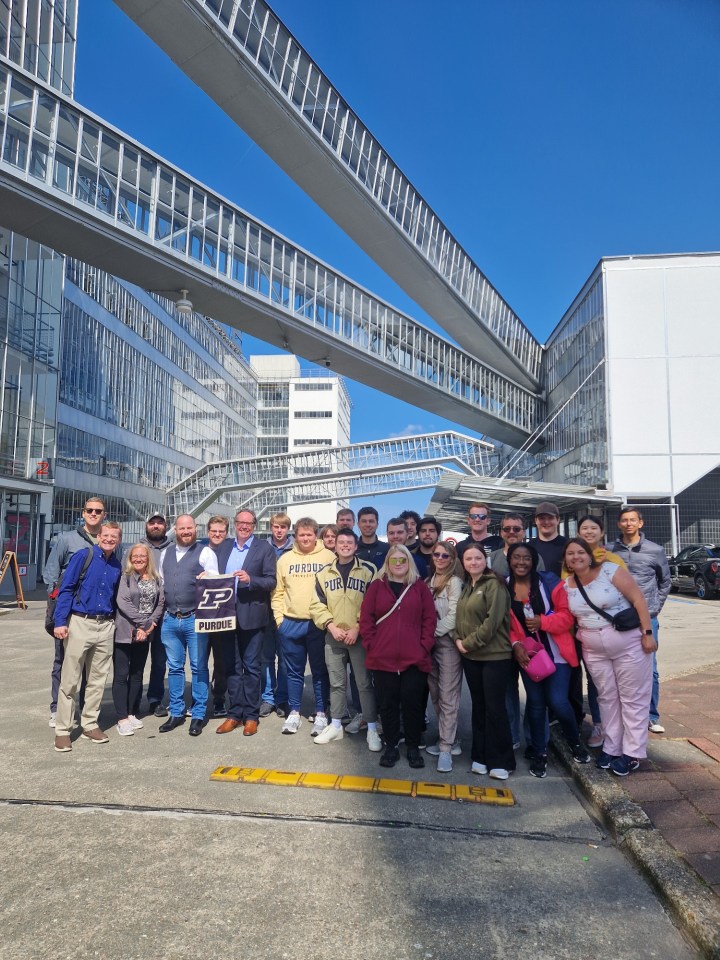
Purdue University’s The Commerce of Cars in Central Europe: From Creation to Cargo (2026)

Purdue University’s The Commerce of Cars in Central Europe: From Creation to Cargo (2026)

The post highlights the importance of collaboration in revitalizing global supply chains post-COVID-19, particularly within the automotive industry. Effective coordination among stakeholders enables firms to anticipate disruptions and enhance resilience. Additionally, a study abroad program at Purdue University fosters experiential learning, cultural understanding, and networking among students, showcasing efficient transportation and supply chain practices in Europe.

Maymester 2025- Purdue University’s The Commerce of Cars in Central Europe: From Creation to Cargo

Maymester 2025- Purdue University’s The Commerce of Cars in Central Europe: From Creation to Cargo

The itinerary for Purdue University’s study abroad program, “The Commerce of Cars in Central Europe: From Creation to Cargo,” mirrored the supply chain of a vehicle manufactured in Germany for the upper class, (or Oberklasse in German).  Pre-trip curriculum research and discussion, course excursions and other experiential learning, and intra-trip classroom curriculum provided insight into [...]

2022 Maymester trip- Purdue Polytechnic’s Central European Multinational Automobile Organization Supply Chain experience

2022 Maymester trip- Purdue Polytechnic’s Central European Multinational Automobile Organization Supply Chain experience

"Purdue Polytechnic's Central European Multinational Automobile Organization Supply Chain experience", the annual 3-credit Maymester study abroad, has finally reconvened after a hiatus during the pandemic.  Students spent three days exploring four unique Central European cities (Munich, Germany; Prague, Czech Republic; Hamburg, Germany; Rotterdam, Netherlands) that are historically important as key cogs in World War II [...]

Culture and Commerce in Central Europe

Culture and Commerce in Central Europe

Cantor (2018) claimed that culture began in the 19th century because up until 1800, the world was too poor to care about art, and as such, the triumph of capitalism created a mass audience for cultural development. The rise of management and economic pedagogy and eventually the division of labor allowed for discretionary income and [...]