

The itinerary for Purdue University’s study abroad program, “The Commerce of Cars in Central Europe: From Creation to Cargo,” mirrored the supply chain of a vehicle manufactured in Germany for the upper class, (or Oberklasse in German). Pre-trip curriculum research and discussion, course excursions and other experiential learning, and intra-trip classroom curriculum provided insight into the most innovative, modern, and efficient European supply chain processes, specifically the manufacture and transport of new automobiles and the mobility of citizens via efficient public transport to work in these facilities. Themes threaded throughout the trip included Industry 4.0/smart manufacturing, innovative process techniques, international business, and global logistics inherent to the production process and subsequent global transport of luxury automobiles made in Germany.
Cultural awareness and global organizational success are directly linked, and the globalization of Indiana’s automobile industry and its impact on the statewide economy require Hoosiers to respect and understand other cultures, even if they don’t have a complete grasp of their organizational culture. Firsthand experiences in adapting to other cultures will facilitate the success of future Indiana employees in today’s global economy, even if that person never again leaves the state of Indiana. Several of the students on the trip work in the automobile supply chain, and most others work and/or will work in related fields. Intercultural development is an important facet of the global supply chain, so it was embedded into the pre-trip curriculum, excursions during the trip, and the final capstone report.
An under-appreciated skillset that is necessary for global travel is the ability to efficiently navigate modes of transportation, such as traveling between and within cities via trains, trams, subway systems, water taxis, etc. Opportunities to develop these vital skills are part of the requirements associated with the three credit hours students earned for this trip. This itinerary would be cost-prohibitive for the enrolled students if tour guides were added to help the group trek from place to place. Therefore, the faculty leaders and students guided themselves, gaining experience that will last them a lifetime through learning by doing. These experiential intercultural learning activities that integrate best travel practices into the curriculum empower Purdue students with a newfound freedom of international mobility. After all, how can someone majoring in supply chain management be expected to expertly move a product around the world when they have never moved themselves in the world?
Multidisciplinary Global Supply Chain Curriculum
In addition to the core trip themes of the global supply chain, sub-themes included free trade, global commerce, smart manufacturing/Industry 4.0, and intercultural development. Historical ebbs and flows in free trade opportunities in Central Europe have dictated the strength of the region’s economies, which have been strong when political limitations on trade have been relaxed, such as in modern times. Similarly, ease of movement of parts and products without restrictions and regulations to and from factories and nearby ports in this regional supply chain has been crucial for profits. Another thread woven throughout this study abroad experience involved learning how political conditions in these regions have often limited or prohibited freedom of mobility.
The following multidisciplinary concepts were integrated into the program, particularly the pre-trip curriculum and final capstone report:
- Supply Chain Management
- Micro/Macro Economics
- Global Logistics
- Organizational Change
- International Business
- Additive Manufacturing (3D Printing)
- Quality Production
- Industry 4.0/Smart Manufacturing
- Strategic Logistics Management
- Industrial Management
Inspired by the Success and Graciousness of Purdue Alumni
Two inspiring additions to the trip, facilitated by the Purdue Alumni Association, were visits with aeronautical engineer Pavi Ravi (two-time Purdue alumnus) and global entrepreneur and higher education instructor in consumer behavior Sandy Rathod (three-time Purdue alumna). Pavi hung out in Munich and Sandy in the Netherlands. Our time with them was truly a highlight of the trip, as Purdue’s global footprint was nowhere better represented than in our activities and excursions with them. Pavi joined us for the tour of Allianz Arena and had dinner with us at Augustiner-Keller, and Sandy attended our South Holland food tour and showed us around her adopted town of Amsterdam with insight and gusto for 3 hours. The students appreciated the helpfulness and generosity of the Purdue Alumni Association for creating these international connections. During our time with Pavi and Sandy, the group saw firsthand the application of the Purdue mantra, “We are Purdue. What we make moves the world forward”.


–


Education by Immersion: Connecting with Students from European Institutions of Higher Education
The group participated in a workshop alongside MBA students from Munich University of Applied Sciences and presented a solution to a case dilemma entitled “Artificial Intelligence for Improving the Procurement Experience of Non-Stock Items at Indian Railways.” Students addressed how differences in national organizational culture in Germany, the US, and India impact the implementation of AI to fill non-stock inventory items in the rail industry via team presentations. Differences in AI in American, Indian, and German cultures were considered as an integral component of the case solution. The winning team were awarded prizes (including Purdue trinkets for the German students). Special thanks go to longtime collaborator Dr. Andreas Rieger for helping to coordinate this activity. An interesting facet of this endeavor was the open access student hang out next door to the classroom, with coolers full of beverages. As usual, the German MBA students were quite gracious into the evenings, with some good memories being made.


Getting Around in Central Europe
Students were able to utilize public transportation and the rail network to attend official group excursions as well as explore on their own upon completion of official group activities. There aren’t many regions in the world that are as passenger-friendly as this one. Employees’ daily commute to production facilities (often from far distances) is seamless, allowing for a broader pool from which to select the best employees and forming a solid organizational culture that can be easily built and sustained. The hustle-bustle of the u-bahns and metro systems after work was a reminder that this capability enhanced the region economically. Rotterdam has been especially attractive in the past several generations due to its efficient regional transportation network. Reflecting the path a product takes via intermodal transportation from where it is produced to where it is used, our movements from place to place in Rotterdam were facilitated by various travel modes, including bicycles, trams, trains, and the Metro (subway) system.


Germany’s Auto Manufacturing Culture
Germany is notable for its history of being manufacturing-intensive and is the epicenter of automobile production on the European continent today. The Federal Ministry for Digital and Transport (2025) noted that “Infrastructure and mobility are the foundation of growth, prosperity and jobs” (p. 2). The capability to efficiently import and export, particularly for products with the renowned “Made in Germany” label, is essential for economic development, especially since many German producers have developed Industry 4.0-based smart manufacturing processes that rely on just-in-time communications and precise deliveries facilitated by robust infrastructure. Constantly-moving cargo and small inventory are tenets of the continuous freight flow of work-in-process and products. Economic development in Germany has long been buoyed during friendly political eras that facilitate ease of movement to enable quick and efficient mobility not only for people, but also for parts, raw materials, components, and products to and from their respective factories and regional markets.
The German economy is quite similar to Indiana’s. Both leverage central geographic supply chains near key regional markets and are heavily reliant on agriculture, commodities, commerce, and transportation infrastructure. Manufacturing employment makes up a vital sector of both economies, particularly supply chain sectors related to the multinational automobile industry. The number of automobile-related industrial jobs in Indiana is an astounding 459% of the national average, and more than 500 automobile-related companies operate in the state, in addition to many more logistics organizations that are indirectly affected.
The curriculum of this trip reflects necessary training and understanding for employment in these industries. Undergraduate students who wish to remain in Indiana after graduation have the chance to leverage these opportunities to gain relevant insight on the trip, as exemplified by the dozens of trip alumni who are now in managerial positions at Toyota in Princeton, IN, and in related supply chain positions in the state and elsewhere. As Indiana’s economy is not relegated only to economic activity within the state, Germany’s influence in the global automobile industry is not confined to the country or even the massive European market; more than 110 German organizations and 15,000 German employees are working in Indiana, many of them in various roles in automobile supply chains. Germany is the leading country in automobile production in the EU and has been called the world’s automotive innovation hub.
The two states of Germany’s southern region (Baden Württemberg, where the trip began, and Bavaria, where the trip shifted several days thereafter) account for a whopping 80% of the production of global luxury vehicles. The state of Baden-Württemberg in Stuttgart is home to the Mercedes-Benz and Porsche factories. Munich (in Bavaria) is home to the BMW and Audi factories (although sadly the BMW factory tour was not attainable this year, even with months of notice). Although no pictures were allowed of the production operations, the group was able to observe the behind-the-scenes production of these world-renowned automobile factories, including the press shop, body shop, paint shop, engine shop, production of interior equipment and seats, and assembly as well as the smooth coordination of various roles utilizing modern smart manufacturing processes.


Dutch Culture of Supply Chain and Logistics
The Netherlands’ history of free trade during peaceful political times has long been enhanced by its proximate geographic location to strong regional economic markets, with infrastructure that facilitates the movement of goods. The Dutch East India Company is considered the first global commerce organization and was the first to issue stock (Petram, 2014). Rotterdam is multicultural, with the highest percentage of foreign-born workers in the Netherlands: 70% of working youth have migrant origins. Its citizens are known for their strong work ethic, and Rotterdam is considered the economic engine of the country.
The Dutch economy consists of the entire country of the Netherlands and historically North and South Holland. It is based on global logistics and geographic proximity to key regional markets, much like the Indiana economy. Many of the exported vehicles manufactured in Germany are transported to the Netherlands to be shipped to consumers around the world, similar to how the products of Indiana’s three multinational automobile factories (Honda, Subaru, and Toyota) are hauled across North America. As a corridor for key regional markets, Indiana has been branded “The Crossroads of America,” and the Netherlands shares the same crossroads spirit. However, unlike Indiana, which has the highest percentage of employees in manufacturing of any US state, the Netherlands employs the lowest percentage of its citizens in manufacturing of all European nations. Today, Indiana exports $1.6 billion in merchandise to the Netherlands annually, and 39 Dutch companies operate in Indiana. Indiana/Dutch investment and trade supports more than 21,000 jobs. The group was able to see the operations in several container terminals from the inside looking out, via our boat tour.


The Port of Rotterdam, #1 Port on the Continent by Throughput
The Port of Rotterdam in South Holland is the largest port in Europe and an integral cog in the European supply chain. It handles more cargo than any American port and is constantly innovating in automation, energy consumption, and technology. Automated cranes pick up and unload containers, but only 50,000 of 19 million containers are inspected in full. Unlike most American ports, the Port of Rotterdam did not experience any backlog of cargo or long queues during the pandemic due to its advanced technological innovations and emphasis on automation rather than manual labor. Oberklasse automobiles are often transported from Germany via rail to the Port of Rotterdam and then loaded onto seagoing Ro-Ro (Roll-on/Roll-off) shipping with parking spaces inside the vessel or via hard-sided container ships that are weatherproof and protected from theft or high-security container ships with security systems and GPS tracking.
In September 2024, several of the port’s container terminals were equipped with shore power facilities to accommodate 5,000 cargo vessels by 2028 in efforts to reduce C02 emissions by 35K tonnes per year, with a goal of being emissions-free by 2035. In 2025, the Rotterdam city transport company announced that it would supply other city organizations’ electricity from its own network, becoming the first European transportation network to offer its excess energy and providing much-needed relief from the strained local power grid. Other measures to encourage sustainable transportation include increasing inland port tolls for motorized vehicles.
There are said to be 13.5 million active cyclists in the country out of a population of 16.5 million, the most per-capita bike usage of any country. Reflecting Dutch culture, our port tour was by bicycle. Our tour guide first shared the history of the construction of various phases, which have tended to coincide with the peak of imports and exports of certain products. For instance, the massive Container Terminal was built in the 1960’s to accommodate the influx of imported American electrical appliances.


Cuisine and Culture
Trying new cuisine is an important part of learning about new cultures. Indiana has the fried tenderloin, while Munich is home to Oktoberfest, which many people around the world associate with the entire country of Germany. Bavarian cuisine, including bratwursts, German potato salad, sauerkraut, warm red cabbage salad, veal, and German pretzels, was inspired by the Bavarian dukes of the Wittelsbach family and was originally intended for the refined tastes of royalty. Today, these foods are especially popular during the Biergarten season.
Common foods in both Indiana and South Holland, such as sandwiches, are traditional lunches for blue-collar workers. Generally, food in Rotterdam is high in carbohydrates because such foods were needed for the working class during the formation of the country. Gouda cheese during our food tour atop the roof of the formerly oldest office building in the Netherlands in 1898 (the Witte Huis) was a highlight. Stroopwafel, picturesque strawberries, and bitterballen were also Dutch food experiences.


Football Culture, European style
“Football” has its own culture in Europe. We had the opportunity to tour two venues that represent the pride and economic impact of the sport in Central Europe. Allianz Arena, home to FC Bayern Munich, which holds the Bundesliga record with 34 league titles, hosted the first NFL game in Germany in 2022 and is preparing to host the final Champions League match on May 31. Our day trip to Amsterdam occurred during an Ajax match south of the city (they fired their coach the next day). The group also toured Feyenoord Stadium (De Kuip, or “The Tub” in Dutch). While it was apparent which club had more glitz and glamour, both football clubs certainly gained some new, lifelong American fans, as their fan shops were again bit hits. Like those outside of the US who eventually adopt a favorite MLB, NBA, or NFL team, the opposite is true of Americans, as they adopt European soccer teams.


The Ability to Get Around
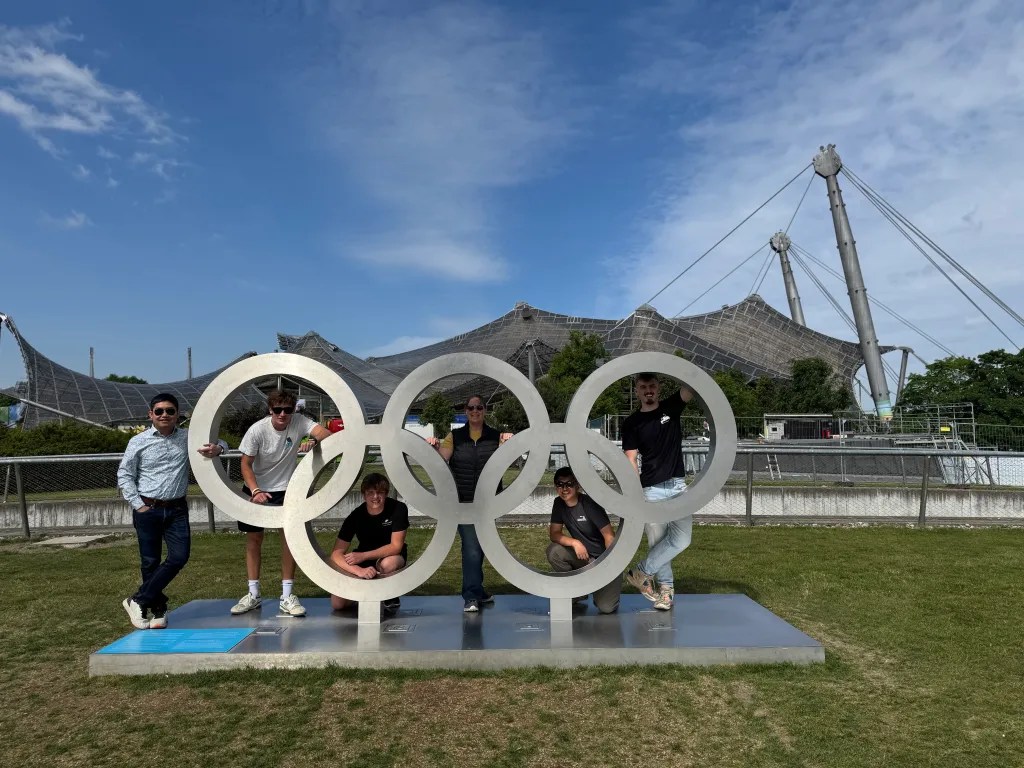
Exploration of oneself and one’s home culture are important outcomes for any study abroad. In addition, visits to trade-related destinations beyond the core itinerary are often quite memorable, particularly if they are associated with aspects of the local culture, and even with a few wrong turns every now and then. Knowledge of public transport allows students to undertake these official excursions, including the Michael Jackson monument in Munich, Cubed Houses in Rotterdam, Windmills of Kinderdijk in Delft, Dachau Concentration Camp in Munich, Anne Frank House in Amsterdam, Olympic Park in Munich, Royal Palace/Munich Residenz in Munich, BMW Welt in Munich, US Embassy in Munich, Mauritshuis Museum in the Hague (where the Girl with a Pearl Earring is displayed), the former commerce hub of Delft, Markthal in Rotterdam, and Rembrandt’s burial plot in an unmarked grave in Amsterdam, among other nearby spots.



The World At Your Fingertips
Public transport passes and mobility access in Germany and the Netherlands means that activities can be undertaken efficiently. Some of the many student-initiated excursions after the group’s official activities included the BMW museum, The settlement where the Pilgrim Fathers planned to set sail for the New World, water squares on a rooftop park, the Marine Corps museum, and a fraternal WWI reenactment beer crawl (after the collaboration w/ German students). These experiences are usually more memorable for students than the structured events.


Purdue’s Global Footprint
As has been the case for the past 7 years, students from the Erasmus University supply chain masters club hung out during several excursions in Rotterdam, including the food tour and the bike tour. The integration of students from Erasmus University also included another tour from doctoral candidate Pieter Zhao, a former Honours Association (undergrad) president at Erasmus University (see below) who is now pursuing his PhD at Erasmus University after spending time in Washington, DC and earning his masters degree in Paris. Students were also introduced to the author of the global transportation textbook utilized in class. These longstanding connections have added substance and strengthened cultural connections through intercultural rapport and goodwill. Purdue’s global footprint is enhanced not only by the bonds with established global partner institutions but also through newly established and continuously strengthened global relationships with colleagues at partner institutions.


Final Thoughts
Increasingly, luxury vehicles manufactured in Germany are exported via of the Port of Rotterdam due to its efficient supply chain capabilities and transportation networks between countries. The economies and cultures of the countries are linked in many ways, although stark cultural and organizational contrasts exist, as explored during this trip. Intercultural competency and efficient multidisciplinary coordination are increasingly crucial to profits, not only between these countries but also for American supply chains. Most importantly, American organizations and the US economy stand to gain from learning about the knowledge, wherewithal, cultural competency, and efficient global automobile supply chains that Central Europeans have long mastered.
–
A special thanks to Dr. Tho Le, co-leader of this trip. Dr. Le’s collegiality, precise nature, and positive outlook lifted up the environment every time.
About Jim Tanoos: The faculty leader for this study abroad wrote “Central Europe in 12 Days on a Limited Budget: Experiencing political and cultural history doesn’t have to be expensive,” a four-part public transportation guide for travelers on a tourist website. Tanoos’ experience is central to the development of this trip, as he was a lecturer at Purdue Polytechnic Lafayette for five years at the campus of multinational automobile organization Subaru-Indiana of America (SIA) (2004-2008) and has published research and presented at global academic conferences since then on the multinational automobile industry. He takes to heart the Purdue mantra, “We are Purdue. What we make moves the world forward” because of the university’s vital role in international endeavors ,and always keeps in mind that it is not any one person or group but Purdue University itself that globalizes students and connects them to the world.


